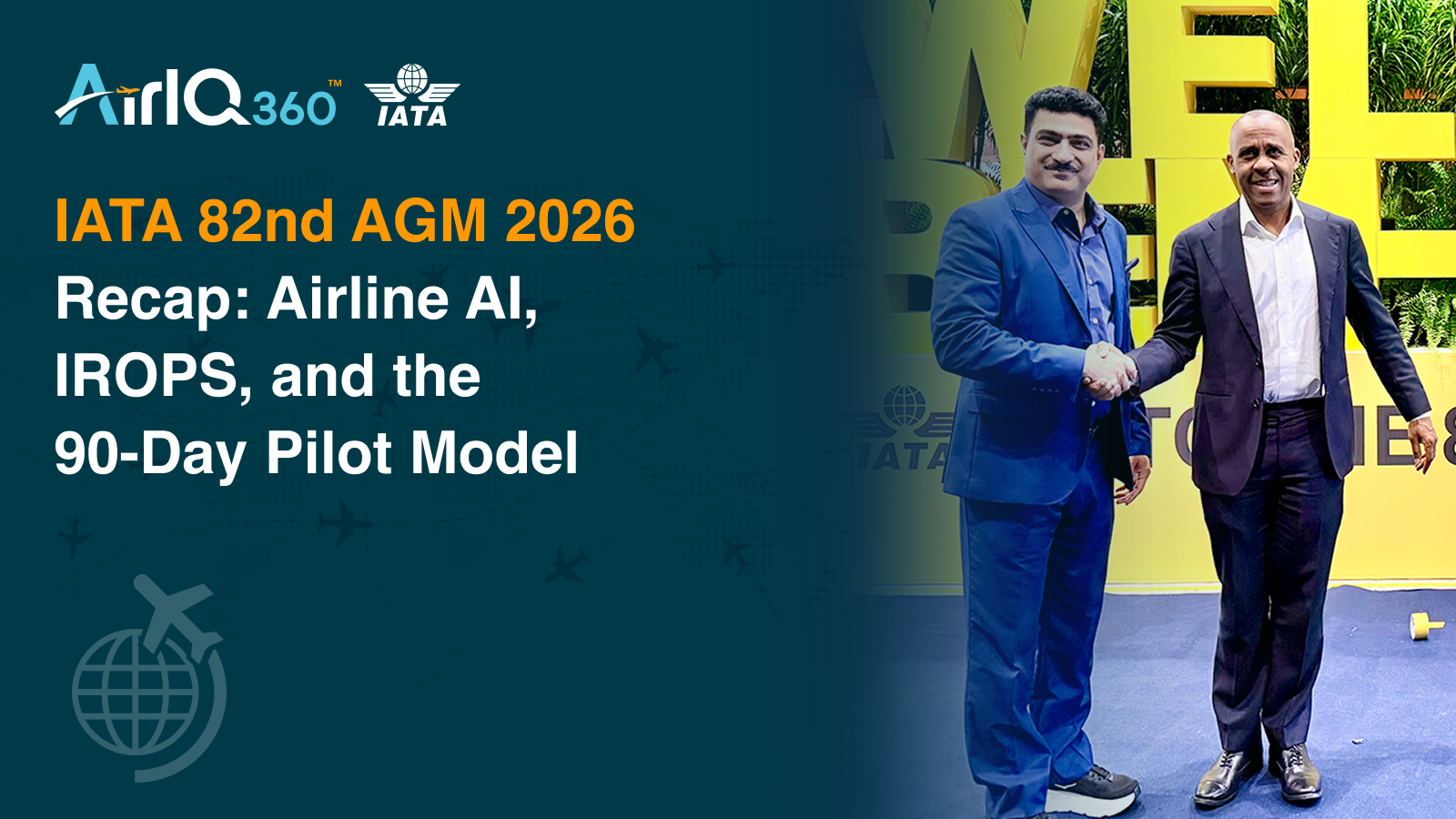
Plumlogix introduced AirIQ360 to global airline executives at IATA's 82nd Annual General Meeting in Rio de Janeiro (6 to 8 June 2026, hosted by LATAM Airlines Group). Three signals came through clearly across the main stage and the sidelines. Airline AI has moved from evaluation to deployment, IROPS is the wedge issue driving urgency, and the 90-day pilot with measurable ROI is now the only pilot model executives will fund. This recap covers what was said, what was heard, and where the industry goes next.
The AGM Set a Different Tone for Airline AI
The 82nd IATA AGM and World Air Transport Summit brought more than a thousand delegates together this June, including airline CEOs, CFOs, CIOs, regulators, and the full spectrum of aviation supply chain leadership. LATAM Airlines Group hosted the event, which was fitting given the region's momentum. LATAM has already delivered a 12 percent operational cost reduction across 145 destinations through AI route optimization and now serves as the LatAm benchmark other carriers are measured against.
The mood was noticeably sharper than at previous AGMs. IATA's latest financial outlook showed a halving of global airline profitability driven by Middle East disruptions and elevated fuel prices, which tightened every conversation about cost, efficiency, and where technology can actually move the P&L. When margin thins, the tolerance for pilots that do not scale disappears. That single dynamic explains most of what we heard over the three days.
Signal 1: Airline AI Has Moved From the Innovation Tent to the Main Stage
Two things stood out from the official program.
AI was no longer treated as a future topic. The CEO panel placed artificial intelligence alongside fuel hedging, engine manufacturer relations, and consolidation as one of the core strategic issues facing the industry. That is a meaningful shift from AGMs even 18 months ago, when AI still sat in the innovation showcase.
The pacing question dominated. IATA Director General Willie Walsh framed it directly in his report on the state of the industry, noting that AI could transform aviation but that airlines must adopt it at the right pace. Every CIO we spoke to came back to some version of that same sentence. The appetite is there. The concern is not whether AI works, it is whether it can be deployed without a rip-and-replace of systems that took a decade to stabilize.
That is the exact gap AirIQ360 was built to close.
Signal 2: IROPS Is the Wedge Issue Driving Every AI Conversation
Nobody at the summit wanted to buy another chatbot. Everybody wanted to solve the surge problem.
Contact center collapse during irregular operations came up in more than half of our conversations, especially with carriers that lived through the 2024 to 2025 winter season. The math has become too painful to ignore. Volumes surge 5 to 10 times normal within the first hour of a mass disruption, hold times cross 45 minutes, and compensation exposure escalates while the queue builds. AI containment at 85 percent and above (the benchmark set in production by Volaris, Air India, and IndiGo) is the number executives are now anchoring on.
The reason IROPS is the wedge is simple. It is the one operational scenario where the cost of the status quo is measurable, the ROI of AI is provable inside a single event, and the passenger experience delta is visible to the entire executive team. Start there, prove it, then expand into everyday service and ancillary revenue.
We covered the underlying mechanics in more depth in Why Airline Contact Centers Collapse During IROPS, and it was the single most-referenced topic in our sideline conversations.
Signal 3: The 90-Day Pilot With Money-Back ROI Is Now the Only Model Executives Will Fund
Pilot fatigue in aviation is real. Multiple executives told us they had run 18-month AI experiments that produced impressive slide decks and zero P&L impact. The bar for a new AI conversation has moved.
Airline leadership now expects three things from any credible AI vendor.
- A 90-day deployment window on a single channel or use case
- A measurable KPI locked in upfront (cost per interaction, containment rate, ancillary yield per passenger)
- A money-back structure if the target is not hit
This is precisely the shape of the AirIQ360 founding partner program. Ninety-day paid pilot, 200,000 dollars, full refund if the platform does not deliver 50 percent or more cost reduction against the baseline. That structure moved several of our conversations from exploratory to scoping within the same week.
What Airline Executives Actually Asked
Three groups showed up at our meetings, each with a different starting question.
- CEOs anchored on cost wanted to talk about AirIQ360 CX and the path to 50 percent cost reduction per interaction. The Volaris case (70 percent cost reduction, 3x call volume with the same headcount, 30 percent CSAT lift) was the reference point they returned to repeatedly.
- COOs anchored on operational resilience wanted to talk about IROPS surge handling and autonomous rebooking. The 91 percent containment number and the sub-60-second rebooking flow drew the most technical follow-up questions.
- CCOs and revenue leaders wanted to talk about AirIQ360 Revenue and the ancillary engine. The OAG 2025 finding that contextual ancillary AI is the confirmed white space in aviation opened conversations that are now moving toward pilot scoping.
Across all three groups, one question repeated. "Can you deploy without disrupting our existing stack?" The answer, because AirIQ360 runs natively on Salesforce Agentforce and integrates rather than replaces, is yes. That single architectural fact shortened almost every conversation.
The Bottom Line for Airline Leadership
The 82nd IATA AGM will be remembered as the moment AI moved from a side track to the main table in aviation. For airlines still evaluating where to start, the sequencing question is now more important than the vendor question. Deploy the module that closes the largest current gap first, measure it in 90 days, and expand from there.
If you were at the summit and want to continue the conversation, or if you were not and want the same briefing we gave to executives on the sidelines, we can set it up.
Book a 30-minute AirIQ360 executive briefing
Schedule a session with Shoaib Chaudhary, CEO of Plumlogix →
You will get the live demo of AirIQ360 handling a real IROPS scenario, a walkthrough of the Volaris benchmark, and a custom ROI model against your airline's volumes delivered within 48 hours of the call.