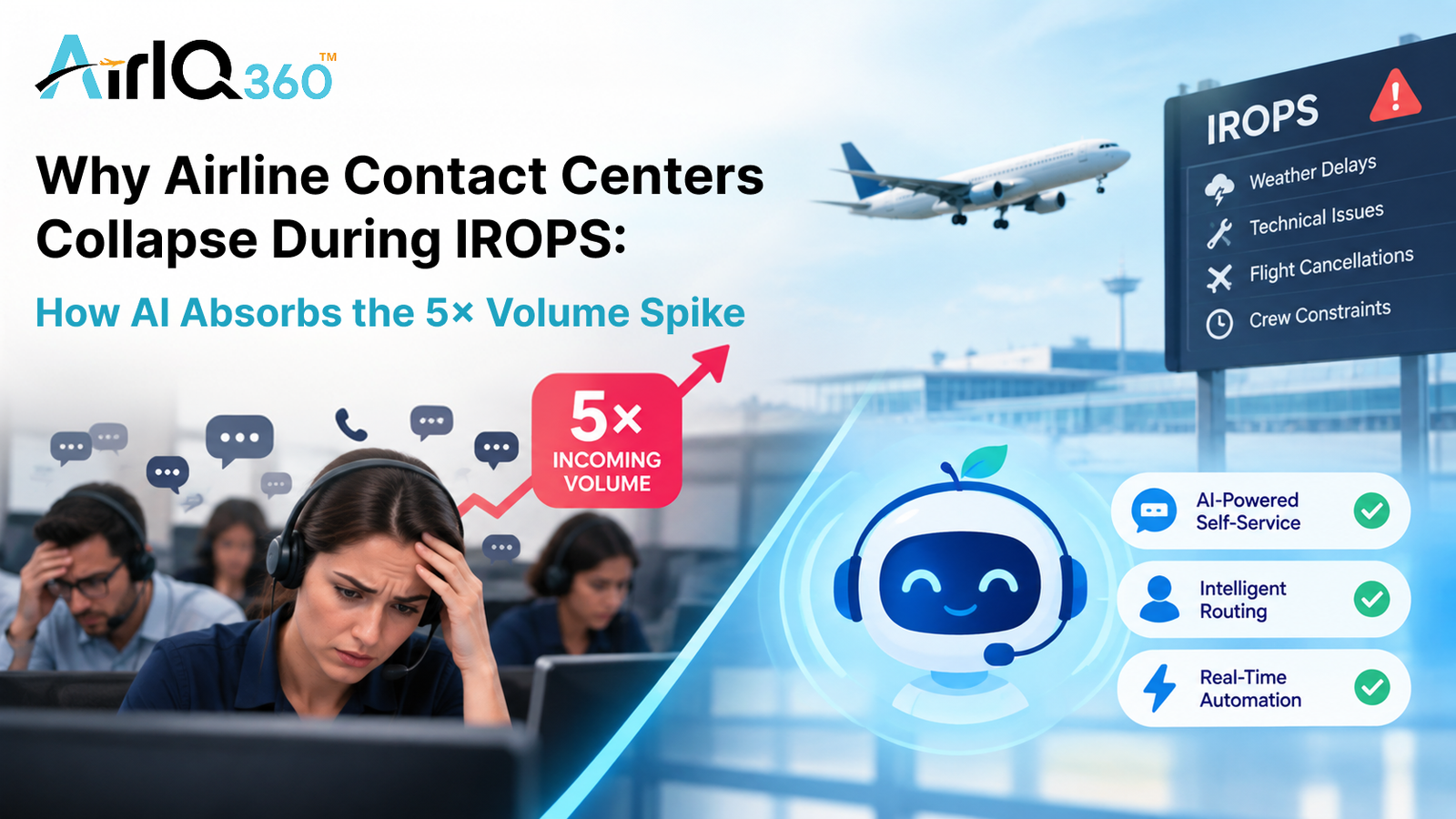
During irregular operations (IROPS), airline contact centers routinely see call volumes surge 5 to 10 times normal within the first hour. Traditional staffing models cannot flex fast enough, hold times cross 45 minutes, CSAT collapses, and compensation costs escalate. AI-powered containment now handles 85 to 93 percent of these interactions autonomously, letting human agents focus on the complex cases that actually need judgment. This piece explains the mechanics of the collapse and the specific AI capabilities that prevent it.
The Problem Every Airline COO Already Knows
Contact center collapse during IROPS is not a technology problem in the way most vendors describe it. It is a queuing theory problem with a compensation clock attached to it.
Here is the picture in numbers. Nearly 1.7 million flights were delayed or canceled in 2024 out of the 7.5 million flights scheduled across the top 10 U.S. airlines and their marketing partners. The DOT's February 2026 Air Travel Consumer Report showed the overall on-time arrival rate for U.S. domestic flights in 2025 was 76.4 percent, meaning more than 23 percent of scheduled flights did not arrive within 15 minutes of schedule. And both cancellations and delays increased in 2025, producing the worst on-time performance for U.S. airlines since 2014.
https://pirg.org/edfund/resources/plane-truth-2025/
The financial exposure is not theoretical. IROPS is now a structural profit risk, with disruption costs exceeding 60 billion dollars annually, driven by EU261 and US DOT compensation, operational inefficiencies, and cascading recovery expense. At the aircraft level, the 2025 average cost of aircraft block time for U.S. passenger airlines was 98.41 dollars per minute. Every minute your rebooking desk stays underwater, that meter keeps running.
https://www.airlines.org/dataset/u-s-passenger-carrier-delay-costs/
Now layer the contact center on top.
What Actually Happens in the First Four Hours of an IROPS Event
The collapse follows a predictable pattern. Understanding it is the first step to designing around it.
Hour 0 to 1: The surge hits.
A weather system grounds 40 flights at a hub. Push notifications go out. Passengers hit the app, then the IVR, then social. Call volumes can surge 10 times within the first hour of a mass disruption event. One documented regional-carrier case saw a 60-agent center built for 2,200 daily calls face 8,000 to 12,000 calls in six hours, with hold times passing 45 minutes.
Hour 1 to 2: The queue turns toxic.
Passengers who cannot get through call again on a second line, message on WhatsApp, and tweet at the same time. Contact volumes look worse than they are because the same passenger is now in three queues. Meanwhile, connection cutoffs create a second wave from downline stations.
Hour 2 to 3: Compensation clocks start firing.
EU261, UK261, and DOT rules kick in based on notification timing and rebooking options offered. Agents who have not reached the passenger in time expose the airline to statutory duty of care costs (hotels, meals, ground transport) plus fixed cash compensation of up to 600 euros per passenger under EC 261.
Hour 3 to 4: The brand damage begins.
Passengers who eventually get through have already told the story on social media. A 2025 study on airline experiences found 81 percent of passengers who rated their journey as "perfect" are highly likely to fly with the same airline again, compared to just 4 percent among those with a "poor" experience. IROPS is the single moment where that rating gets set.
Why Traditional Fixes Do Not Solve This
Every airline has tried at least one of these. None of them close the gap.
- Overstaffing for peak. Financially impossible. Labor is already the largest single cost component at 28 percent of total operating costs, with IATA projecting airline labor costs would reach 253 billion dollars in 2025, up 7.6 percent year on year. No CFO signs off on staffing for a once-a-month event.
- Outsourced BPO surge capacity. Helps at the margin, but training on GDS systems (Amadeus, Sabre, Travelport), fare rules, and EU261/DOT compliance takes weeks. Surge agents borrowed from generalist pools rebook slowly and inconsistently.
- IVR expansion and better hold music. Deflects nothing. Passengers escalate to another channel.
- Static chatbots. Handle FAQ traffic, then fall over the moment a passenger asks to be rebooked on a specific alternate.
The pattern is clear. Adding human capacity linearly cannot solve a problem that scales non-linearly. The only lever that scales instantly at zero marginal cost is software.
How AI Changes the Equation
The category that solves this is not "chatbots." It is autonomous passenger service, powered by AI that can read the operational picture, act inside the PSS and GDS, and communicate across every channel a passenger uses. The results in production are no longer speculative.
1. Containment at 85 percent and above
Containment is the percentage of passenger interactions resolved end to end without a human agent. This is the number that matters.
- Volaris, Mexico's largest airline, handles three times the call volume with the same number of agents and now resolves 85 percent of digital customer interactions immediately through automated bots, including complex use cases such as check-in.
- Volaris achieved a 70 percent reduction in cost per interaction and a 30 percent CSAT increase across five million yearly customer interactions.
- Industry providers consistently report AI-assisted deflection handling 45 to 60 percent of routine inquiries, freeing human agents for the complex, high-emotion IROPS cases that actually need them.
The AirIQ360 CX module was engineered against these benchmarks and delivers 91 percent containment during IROPS surges specifically because it can execute rebookings autonomously, not just quote policy.
2. Autonomous rebooking, not menu navigation
The step function is when the AI stops routing passengers to information and starts acting on their booking. Reading the PNR, checking seat inventory on alternate flights, applying fare rules, issuing the new boarding pass, pushing it to Apple Wallet, and sending confirmation on the channel the passenger used to start the conversation. All in under 60 seconds.
This is the difference between a chatbot and passenger rebooking automation. The former deflects. The latter resolves.
3. Proactive outreach before the phone rings
The most cost-effective interaction is the one where the airline contacts the passenger first. When the operations control center marks a flight as cancelled, the AI generates rebooking options for every affected passenger and pushes them on WhatsApp, SMS, or app notification with a one-tap accept flow. The passenger is rebooked before they think to open a support channel. Inbound volume for that flight collapses.
4. Multi-channel, multi-language, one brain
A leading US-based airline managed 30 million voice calls in 2022, with volumes spiking up to fivefold during disruptions. Handling that spike across WhatsApp, web, SMS, app, and social, in 30 plus languages, cannot be done with channel-specific tools. It requires one AI layer sitting behind every channel with a single view of the passenger and the operation.
The Real Contact Center Scalability Model for Aviation
Here is what elastic capacity looks like when the architecture is right.
| Layer | What it handles | Marginal cost of surge |
|---|---|---|
| AI passenger service | Rebooking, IROPS, baggage, loyalty, refunds | Near zero |
| AI agent co-pilot | Complex cases with agent in the loop | Fixed per seat |
| Human agents (senior) | High-emotion, high-value, edge cases | Salary + overtime |
| BPO overflow | Long tail voice traffic | Per-minute rate |
The economics only work if the top layer is doing 80 percent or more of the work. Everything else is triage.
Most airlines do not need all three modules on day one. They need the one that closes the biggest gap in the current operation, whether that is agent productivity, passenger containment, or ancillary yield. The AirIQ360 Solutions overview maps each module to the specific KPI it moves and the 90-day deployment path.
The Bottom Line for Airline Leadership
Contact center collapse during IROPS is not an inevitable cost of running an airline. It is the predictable output of a staffing model that cannot flex and a technology stack that was not built for autonomous action. The airlines already past this problem, Volaris, Air India, IndiGo, are not doing anything the rest of the industry cannot do. They just started earlier.
The 90-day question for your team is simple. If the next major weather event hits your hub tomorrow, do you want to be running the same playbook you ran last winter?
Ready to see what 91 percent containment looks like on your operation?
Book a live demo of AirIQ360 handling a real IROPS scenario →
We will run your actual disruption volumes through the platform and deliver a custom ROI model for your airline within 48 hours. If the 90-day pilot does not deliver 50 percent or more in cost reduction, you get your money back.
Frequently Asked Questions
What does IROPS mean in airline operations?
IROPS stands for irregular operations. It covers any deviation from schedule that requires active passenger recovery, including weather cancellations, mechanical delays, crew unavailability, and system outages. Weather is the most frequent cause, with 39 percent of business travellers reporting some level of weather-related disruption in 2025.
Why do airline contact centers collapse during IROPS?
Because staffing is sized for average volume, not peak. Volumes surge 5 to 10 times normal within an hour, hold times exceed 45 minutes, and passengers escalate across multiple channels, further inflating apparent volume.
What is a realistic AI containment rate for an airline?
Best-in-class production deployments now sit between 85 and 93 percent for digital channels, with voice trailing at 60 to 75 percent depending on IVR design.
Can AI actually rebook passengers, or just answer questions?
Modern platforms execute rebookings directly in the PSS and GDS, issue new boarding passes, and confirm on the passenger's channel of choice, typically in under 60 seconds.
How long does deployment take?
On Salesforce Agentforce, AirIQ360 deploys in 90 days on a single channel with measurable ROI before scaling.