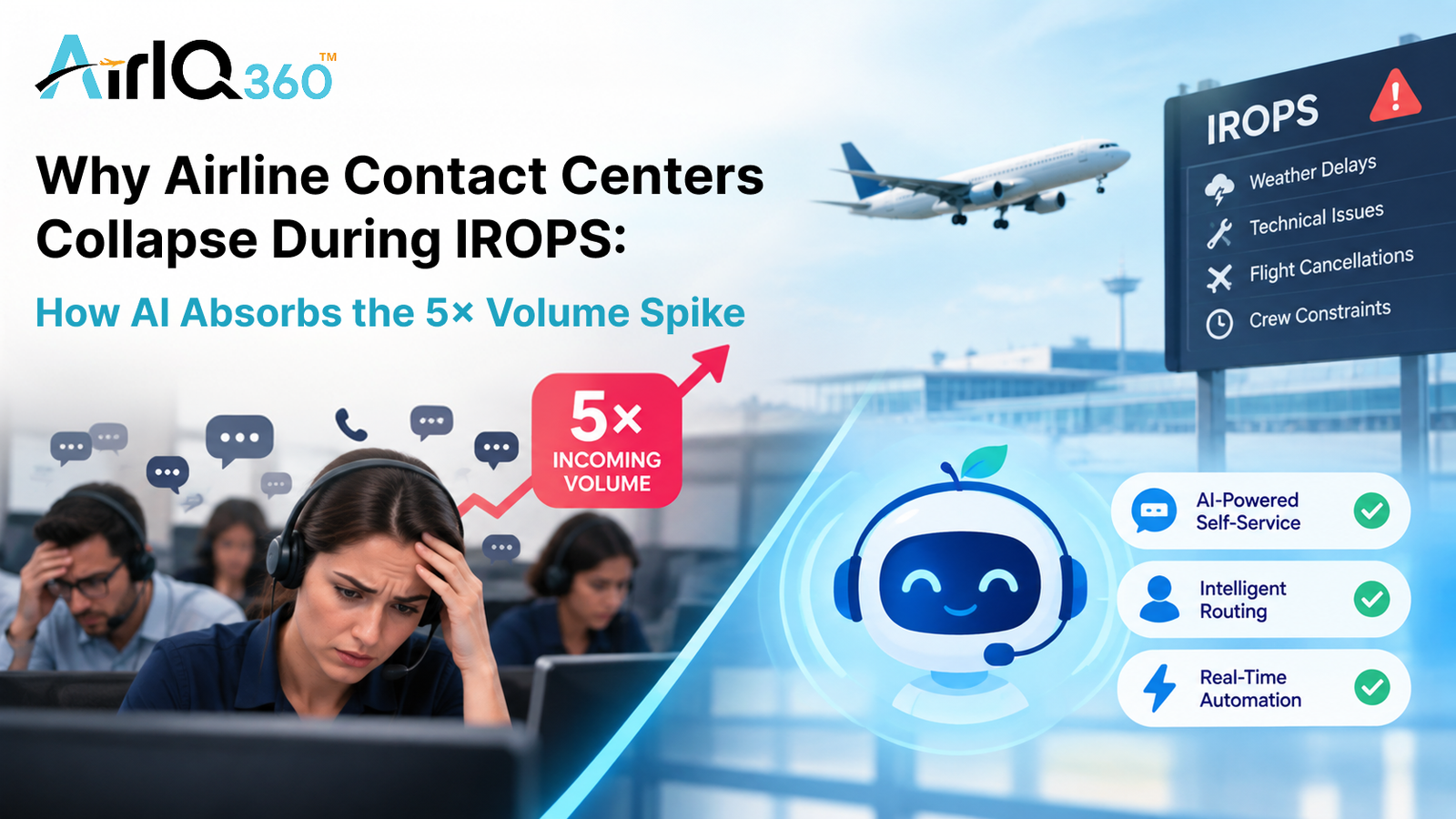
December is the hardest month of the year for airline customer service. Holiday travel pushes load factors to their peak, and winter storms arrive at the same time. When a storm hits a hub, hundreds of flights can be cancelled in a few hours, and thousands of passengers reach for their phones at once.
Airlines that get through winter IROPS well do four things before the first storm arrives. They forecast contact volume for disruption days rather than normal days. They automate the most common requests, especially rebooking. They contact passengers proactively before passengers call. They make sure every agent has instant access to the right policy and compensation rules. Platforms like AirIQ360 bring all four together, so airlines can prepare in weeks rather than months.
This playbook explains each step in detail so your contact center is ready before December begins.
What Is IROPS and Why Does December Make It Worse?
IROPS stands for irregular operations. It covers any event that disrupts the planned flight schedule, such as weather, air traffic control restrictions, crew shortages, technical problems or airport closures.
Winter makes IROPS worse for three reasons.
1. Demand is at its highest. Holiday flights are full, so there are very few empty seats available for rebooking. Every cancelled passenger competes for the same limited inventory.
2. Disruptions cascade. Snow and ice slow deicing and ground operations. Aircraft and crew end up in the wrong cities, and one storm can affect a network for several days.
3. Passengers have more at stake. People travel in December for family gatherings, holidays and once a year reunions. A missed connection feels personal, and frustration rises quickly.
The industry has already seen what happens when these pressures combine. During Winter Storm Elliott in December 2022, Southwest Airlines cancelled close to 17,000 flights over the holiday period. Passengers waited hours on hold, and the US Department of Transportation later issued a record $140 million civil penalty. That event showed that IROPS is a customer service problem as much as an operational one.
Why Airline Contact Centers Struggle During Winter Storms
Most contact centers are staffed for an average day. IROPS is not an average day.
When a storm forces mass cancellations, contact volume can rise five to ten times above normal within the first hour. Phone queues grow faster than any team can answer them. Hold times stretch from minutes to hours. Passengers who cannot get through call again, message on social media and try every channel at once, which multiplies the load.
Agents are also slower during disruptions. Every case needs a booking search, a check of available flights, a fare rule review and a compensation decision. Under pressure, mistakes increase, and so do repeat contacts.
Hiring temporary staff rarely solves this. New agents need weeks of training on reservation systems and policy, and storms do not give that kind of notice.
The Winter IROPS Playbook: 8 Steps to Prepare Your Contact Center
Step 1: Build a Disruption Volume Forecast
Start with data from last winter. Look at your worst three disruption days and answer these questions:
- How many contacts arrived per hour at the peak?
- Which channels did passengers use most?
- What were the top five contact reasons?
- How long did it take to clear the backlog?
Use these numbers to build a separate forecast for disruption days. Plan for at least five times normal volume at your largest hubs. This becomes the baseline your staffing, technology and escalation plans must meet.
Step 2: Identify Which Contacts Can Be Automated
Most IROPS contacts fall into a small number of categories:
- Rebooking after a cancellation
- Flight status and delay updates
- Missed connections
- Refund requests
- Hotel and meal vouchers
- Baggage questions
Many of these follow clear rules and do not need a human agent. Rebooking in particular is predictable: find the booking, show available alternatives, confirm the choice and issue a new boarding pass.
An AI passenger service platform can handle these requests from start to finish. With AirIQ360 CX, a passenger whose flight is cancelled can be rebooked through chat in under a minute, with the new boarding pass sent straight to their email and mobile wallet. No agent is involved, and no queue forms.
The goal is to keep human agents free for the cases that truly need them, such as passengers with medical needs, unaccompanied minors, group bookings and complex itineraries.
Step 3: Switch From Reactive to Proactive Communication
The best way to reduce inbound volume is to reach passengers before they reach you.
As soon as a cancellation is confirmed, send each affected passenger a message that includes:
- What happened, in plain language
- Their rebooking options, with the best one already suggested
- A simple way to accept or change the option
- What support they are entitled to, such as meals or a hotel
- How to get a refund if they prefer not to travel
When passengers receive clear options without asking, most of them accept and never call. Proactive outreach turns a flood of anxious calls into a set of quick confirmations.
Use the channels your passengers actually use. In many markets, WhatsApp gets a faster response than email or SMS. A strong passenger AI should work across WhatsApp, web chat, SMS, your mobile app and social media with one consistent conversation.
Step 4: Give Every Agent an AI Co-Pilot
Even with automation, human agents will handle the hardest cases during a storm. Those cases take the longest and carry the most risk of error.
An agent co-pilot such as AirIQ360 Assist helps in three ways:
- Instant policy lookup. The correct rule, whether that is EU261, US DOT refund requirements or Canada’s APPR, appears before the agent starts typing.
- Drafted replies. The AI prepares a complete response based on the booking and the policy, and the agent reviews and sends it.
- Live translation. Agents can support passengers in any language without transferring the case.
This lets one agent handle several conversations at the same time with fewer mistakes. It also makes temporary or cross trained staff useful much faster, because the AI carries much of the policy knowledge for them.
Step 5: Prepare Your Compliance Rules in Advance
Weather disruptions come with specific regulatory obligations, and they differ by region.
United States. Under the DOT rules on automatic refunds, passengers are entitled to a refund when their flight is cancelled or significantly changed and they choose not to travel, regardless of the reason. Airlines must process refunds promptly in the original form of payment.
European Union. Under EU261, severe weather is usually treated as an extraordinary circumstance, so cash compensation may not apply. However, the duty of care still applies. Airlines must provide meals, refreshments and hotel accommodation where needed, along with rerouting or a refund.
Canada. Under APPR, weather falls outside the airline’s control, but airlines must still rebook passengers and keep them informed.
Load these rules into your knowledge base and AI tools before December. During a storm, agents should never have to search for policy. Wrong answers lead to complaints, regulatory exposure and repeat contacts.
Step 6: Create a Clear Escalation and Staffing Plan
Decide in advance what happens when a storm warning is issued:
- 72 hours out: Review the forecast, confirm on call staff and check system capacity.
- 48 hours out: Offer passengers free changes through a travel waiver and promote self service options.
- 24 hours out: Activate extended shifts, move the AI to surge mode and prepare proactive message templates.
- During the storm: Route simple requests to AI, prioritize vulnerable passengers for human agents and update status messages every hour.
- After the storm: Clear the backlog, process refunds and vouchers and follow up with affected passengers.
Assign one owner for the contact center response so decisions are not delayed.
Step 7: Offer Helpful Options, Not Just Apologies
Disruption is stressful, but it is also a moment where the right offer can improve the experience. A passenger facing a long delay may welcome lounge access. A passenger rebooked on a later flight may value a seat with more legroom.
With a contextual ancillary engine such as AirIQ360 Revenue, these offers are triggered by the real situation, such as a delay or a rebooking, rather than sent as generic promotions. The key is tone. Offers should feel like useful choices, never like the airline is profiting from the passenger’s bad day. Done well, this recovers some of the revenue lost to disruption while giving passengers more comfort.
Step 8: Test Your Plan Before the First Storm
Run a simulation in November. Pick a realistic scenario, such as a hub closure for six hours on a peak travel day, and walk through it:
- Can your AI handle five times normal volume without slowing down?
- Do proactive messages go out within minutes of a cancellation?
- Can agents find every policy they need in seconds?
- Do escalations reach the right people?
Fix the gaps you find now, while there is still time.
Winter IROPS Readiness Checklist
Use this list to confirm your contact center is ready for December:
- Disruption day forecast built from last winter’s data
- Top IROPS contact reasons identified and mapped
- Automated rebooking live on your main digital channels
- Proactive cancellation messages written and tested
- WhatsApp and other high use channels connected
- Agent co-pilot loaded with current EU261, DOT and APPR rules
- Escalation plan with clear owners and timelines
- Priority handling rules for vulnerable passengers
- Contextual offers configured with careful tone guidelines
- Full storm simulation completed in November
How AI Changes the Outcome of a Winter Storm
Without automation, a winter storm follows a familiar pattern. Queues explode, agents burn out, passengers wait for hours and complaints follow for weeks.
With an AI first approach, the pattern looks different. Passengers receive rebooking options before they think to call. Most rebookings finish in chat within a minute. Human agents focus on the complex cases with full policy support. The contact center absorbs the spike instead of collapsing under it.
AirIQ360 is built for exactly this situation. Running on Salesforce Agentforce, it combines passenger AI, agent assist and contextual offers in one platform, and it can be deployed through a 90 day pilot. That means an airline that starts planning now can be ready for the next winter season with measurable results.
Frequently Asked Questions
What does IROPS mean for airlines?
IROPS means irregular operations. It refers to any disruption to the planned flight schedule, including weather, air traffic restrictions, crew issues and technical problems.
How much does contact volume increase during flight cancellations?
During major disruptions, airline contact volume can rise five to ten times above normal within the first hour, especially at large hubs during peak travel periods.
How can airlines reduce call volume during winter storms?
The most effective method is proactive communication. When passengers receive rebooking options automatically as soon as a flight is cancelled, most accept them without calling. Automating rebooking through chat and messaging channels reduces volume even further.
Can AI rebook passengers automatically?
Yes. Airline specific AI platforms such as AirIQ360 can find a passenger’s booking, present available alternative flights, confirm the new itinerary and send a boarding pass without a human agent. During disruptions, AirIQ360 can handle up to five times normal contact volume, so passengers are rebooked in minutes instead of waiting on hold.
Do airlines pay compensation for weather delays?
In the EU, severe weather is usually an extraordinary circumstance, so cash compensation under EU261 often does not apply, but airlines must still provide care such as meals and hotels. In the US, passengers are entitled to a refund if their flight is cancelled and they choose not to travel, regardless of the cause.
When should airlines start preparing for winter IROPS?
Ideally in September or October. This allows time to analyze last year’s data, configure automation, train staff and run a full simulation in November.
Get Ready Before the First Storm
Winter storms are certain. Contact center collapse is not. Airlines that prepare now will protect their passengers, their agents and their reputation when December arrives.
See how AirIQ360 handles a live IROPS scenario. Book a demo and we will walk you through a real winter disruption, from cancellation to rebooking in under a minute.